
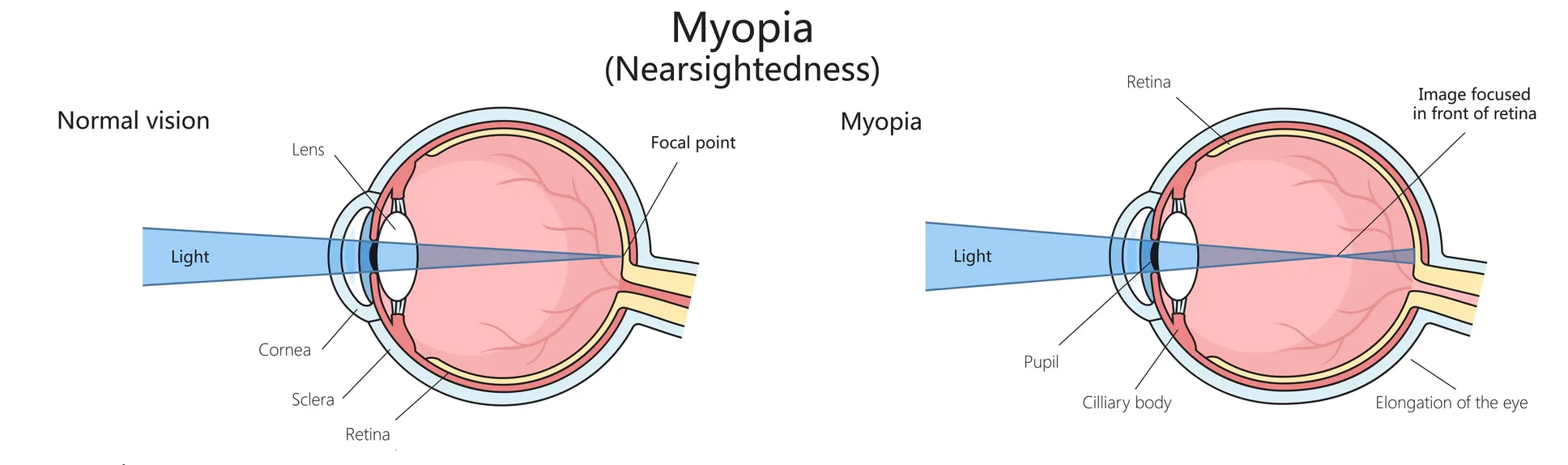
Myopia is commonly called nearsightedness. It generally occurs when an eye ball is too long. Your child usually starts with mild prescription, but with time their eyes will continue to lengthen and the myopic prescription will continue to get stronger. This growth results in a stretching of, and tugging on, the delicate retina. This stresses the macula, at the center of the retina where your child’s most acute vision comes from. Your child may need myopia control. View this informative reference sheet.

Increases in Myopia
We don’t know all the influencing factors that cause progressive increases in myopia, commonly called nearsightedness, but these escalations are definitely linked to less time outdoors and the proliferation of digital device use. We are seeing a dramatic increase in myopia, particularly among young people. Soon 50% of American children will be myopic. Starting myopia control treatments early is imperative.
What does my child see?

Representation of vision with -3.00 diopters of myopia
Experience what your child is missing with increasing amounts of nearsightedness in this simulator from Cooper Vision. Poor vision, damaged eyeballs and a lifetime of wearing thick glasses are the consequences of not controlling myopia in your child.
Understanding your Child’s Myopia
Myopia or nearsightedness is commonly diagnosed in childhood and can worsen over time. Increases in myopia will increase the risk of more severe vision complications later in life. Controlling these increases in nearsightedness is critical to the preservation of your child’s vision. Dr. Metsch specializes in myopia control.
Check out this quick guide to understanding your child’s nearsightedness courtesy of MyMyopia.com.
Impact on eye health
The units of measurement for myopia are diopters. With each additional diopter of increase in prescription there is a 67% increase in risk of damage to macula the point of sharpest vision, permanently damaging your child’s eyesight. There are significant increases in additional eye health conditions associated with increased myopia. Controlling myopia is critical to lifelong good vision.
| Increase in Maculopaty | Increase in Retinal Detachment | Increase in Glaucoma | Earlier onset of Cataracts | |
| This can lead to permanent central vision loss | This requires urgent surgery and can result in possible vision loss | While medical and surgical advances control most cases of glaucoma, many result in some peripheral vision loss | Treatable only by surgery | |
| Your Child's Presciption | ||||
| -2.00 D | 3x | 2x | 2x | 2x |
| -6.00 D | 9x | 41x | 3x | 3x |
| -8.00 D | 22x | 127x | 5x | 6x |
Here’s the problem
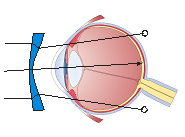
Vision corrections for nearsightedness focus light on the central retina providing sharp vision. The light that falls in the periphery, however, focuses beyond the eyeball. Research proves that this triggers the eye to grow in an attempt to bring those peripheral rays into focus, causing the eyeball to lengthen and the nearsightedness to increase. Therefore conventional vision correction contributes nothing to myopia control and actually encourages increases in myopia.
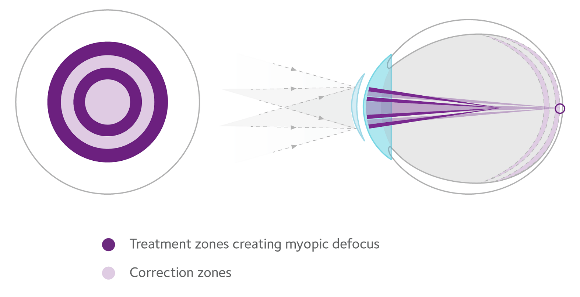
One of the best options for controlling myopia and slowing the increase in eyeball length are specially designed one day soft contact lenses.MiSight® 1-Day contact lenses are FDA approved for myopia control. These soft, safe, and comfortable lenses have treatment zones that help to refocus the peripheral light onto or slightly in front of the retina, encouraging less lengthening of the eye. Thorough, documented multi-year studies show a 59% reduction in eyeball growth when these lenses are utilized.
The ActivControl™ technology in MiSight® I day contact lenes includes vision correction zones along with the treatment zones. This design corrects your child’s vision while training the eye to resist changing shape, protecting your child’s eyesight
Here are the solutions
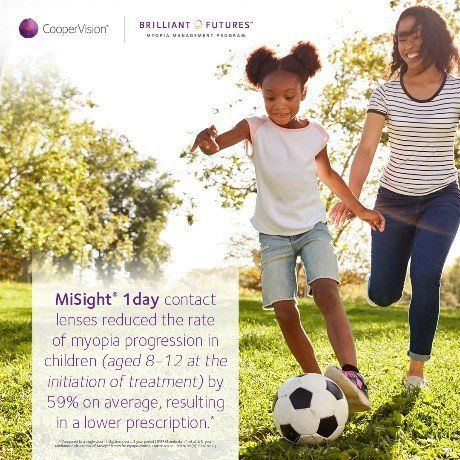
We cannot eliminate myopia. Our goal is to cut its progress in half. The more we can control the final prescription the better vision and fewer complications your child will experience in his lifetime.
In addition to MiSight, there are two other alternative treatments we make available. The first is Low Dose Atropine. These are drops put in just before bed. Atropine is a dilating agent, but at this dosage it does not open the pupil significantly, if at all. It doesn't blur vision either, as it does at the dilating agent strength. This modality has been safely and effectively used for myopia control for decades and we have had great success employing it in our practice. The second alternative is the Stelles spectacle lens from Essilor. This has been used in Europe and Canada for years and has finally been FDA approved for US dispensing. The lens has a proprietary design that defocuses the peripheral rays of light, just like MiSight, thereby inhibiting axial length growth of the eye.
Let’s get started.